I have been spending some time with Baxter in Beijing.
Our lab had bought one three years earlier:
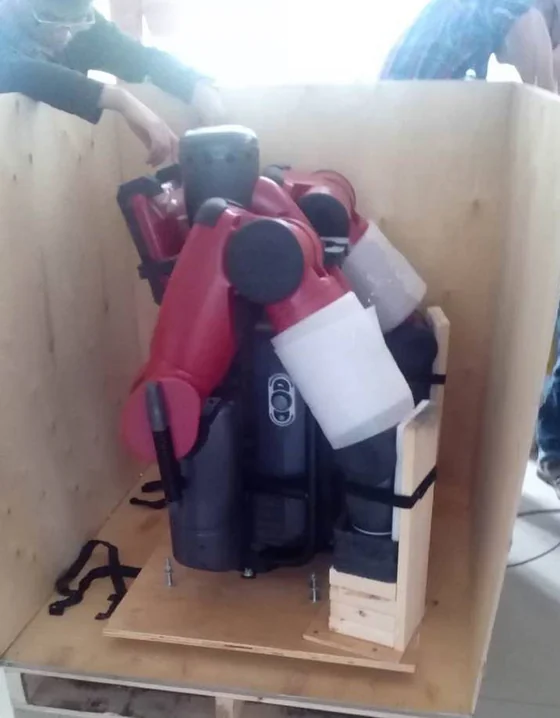
Back then, I mostly used it for motion planning. Then I found other robots to play with and never got much further with Baxter. With no other robots to play with in Beijing, I finally tried some dynamics-based human–robot interaction.
You could say I finished the remaining six sevenths of the project from Building one seventh of a collaborative robot.
For the underlying ideas, see my earlier discussion of how the KUKA LBR iiwa implements precise force control.
A look at the experiment
Here is the video. If you want to skip the technical introduction, start at 2:30 and turn on the sound.
Watch the video in the original article ↗
Comparing predicted and measured torque
From a control perspective, “joint position control” cannot be separated from the rest of the machine. Power supply → control electronics → drive → motor → gearbox → force sensor → environment: every part of that chain is coupled through energy, and an input at one point affects the others.
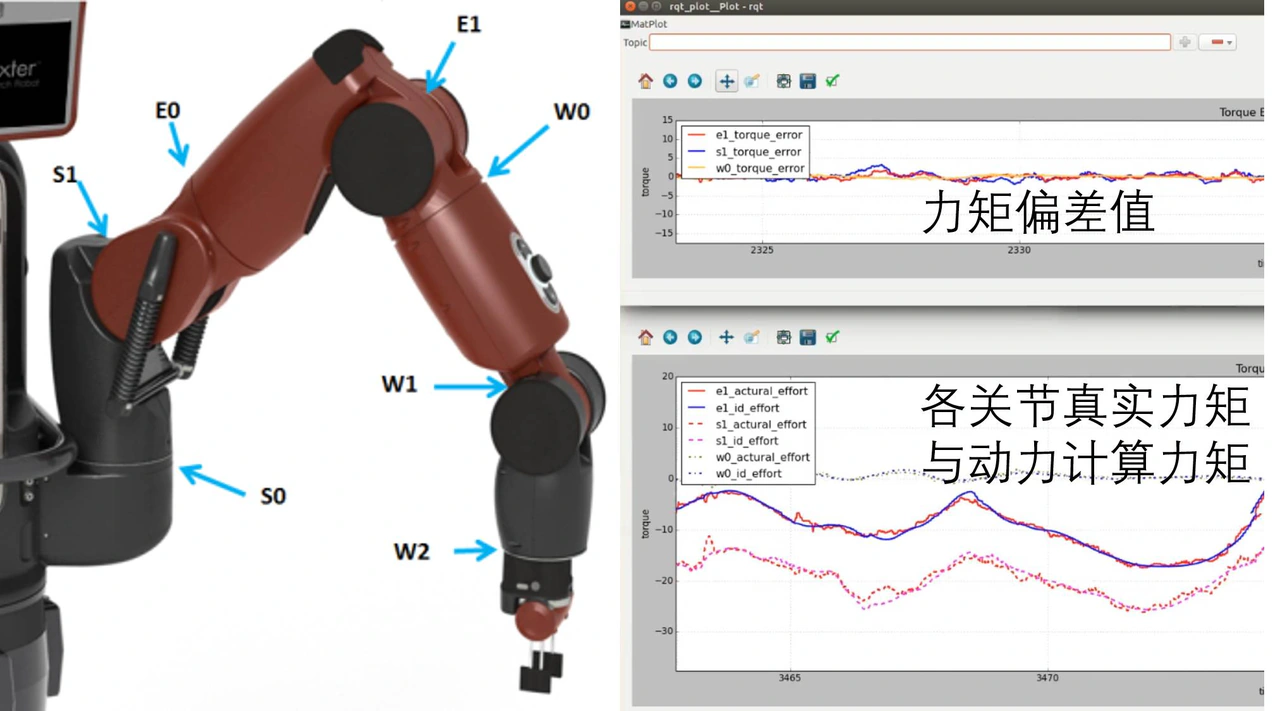
A dynamic model lets us calculate the torque needed to produce a particular motion, accounting for inertia, Coriolis and centrifugal terms, gravity, and so on. If the robot touches something, the external force causes the measured torque to differ from that prediction. That discrepancy gives us a way to detect contact.
Hand guiding and collision detection
As on the single-joint rig, we can use the same ideas for hand guiding:
Baxter already has its own hand-guiding feature, but it requires holding the robot's wrist.
Collision detection works along similar lines:
Baxter also includes its own collision-detection module. Writing our own gives us control over the sensitivity and access to the external-force estimates for all the joints. That leaves room for more experiments.