After seeing a few old friends recently, I noticed that everyone was talking about embodied intelligence. I have always followed robotics closely, so on the flight home I tried to work out where I stood. What would it take to build a general-purpose robot, and which technical paths might get us there? Behind those practical questions are some much larger ones:
What is human consciousness, and how does it arise? Why can people learn to generalize across so many different activities? Could we build something with that ability?
Two starting points
When I first heard “embodied intelligence,” my reaction was: “Another new term? Isn't this just robot learning?”
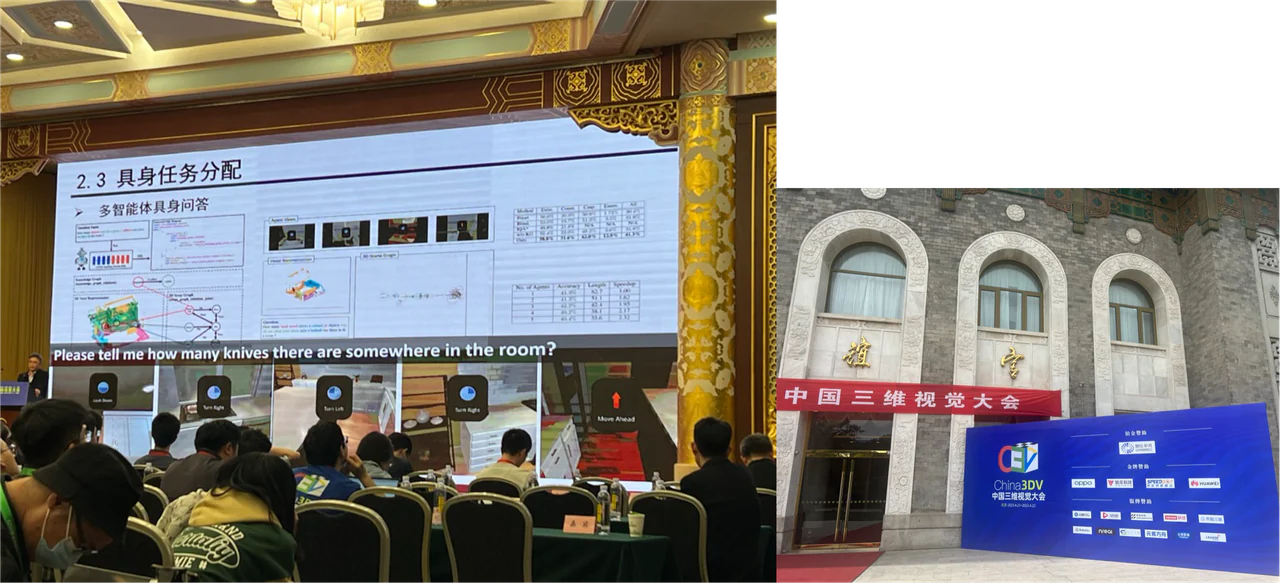
The 2023 China 3D Vision Conference.
The conference in April 2023 changed that. For the first time, I was looking at robotics from an AI researcher's perspective rather than my usual one.
AI has advanced rapidly in vision and natural language. In many areas it has approached, or even exceeded, average human performance. Yet most of those achievements have remained inside the computer. If an AI already understands enough, could we give it a body—let it sense the physical world, control actuators, and affect its surroundings?
AI has matched or surpassed people at many computer-based tasks; perhaps an AI with a body could do the same. That seems to be the intuition behind much of the enthusiasm. Advocates of embodied intelligence start with the intelligence. Traditional roboticists tend to start with the body.
Robotics in early 2024 still has a familiar limitation: most deployed robots repeat fixed motions without much intelligence. They work in highly structured settings such as automobile manufacturing and generalize poorly. Every application needs its own design and tuning. Robotics looks busy from a distance, but up close, each deployment is difficult and each individual market is small.
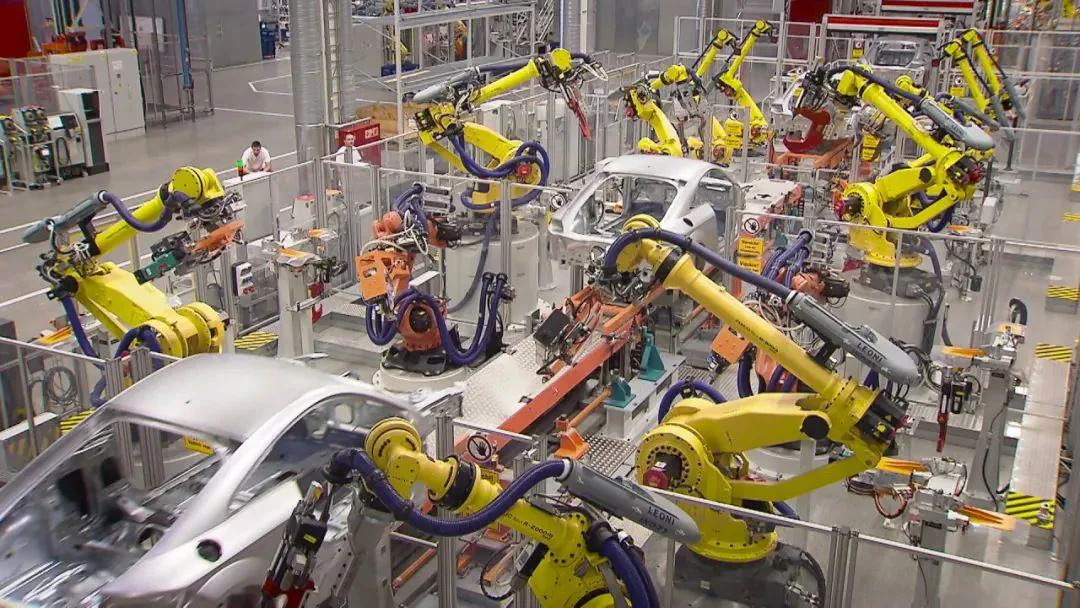
One of the most widespread applications of robots.
There is broad agreement that software must make robots more capable. I see two main ways to approach that:
1. Give intelligence a body. Build large models that develop a deep understanding of the world and its physical laws. The AI need not belong to any particular body: it can connect to different actuators or robot platforms, with fine-tuning allowing it to control each one and perform different tasks. Here, generality comes from the intelligence.
2. Make a body intelligent. Use 3D vision, motion planning, reinforcement learning, and imitation learning to improve a robot's perception, decisions, and actions. The aim is to help that robot cope with changes in its environment and become useful in more situations. Here, we start with the body and give it more intelligence.
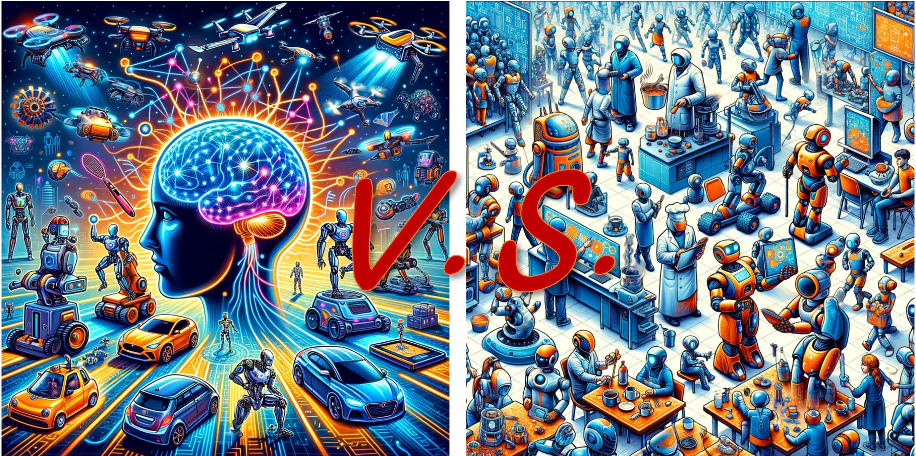
Giving intelligence a body versus making a body intelligent.
I want to look at where each of these paths might take us, and what stands in the way.
Giving intelligence a body
The progress of large models in 2023 makes this the natural place to start. Researchers with a robotics background often object that the physical world is much more complicated than the digital one, that different robots have different kinematics and dynamics, and that collecting large amounts of real-world data is difficult. From that perspective, the approach can produce prototypes and demos, but little more—at least for now.

Image source: Google RX-2.
I see this approach as starting with the end in mind. People are intelligent enough to learn how to use many different tools: we watch videos, follow verbal instructions, or learn with someone guiding our hands. If artificial intelligence becomes capable enough, it should, in principle, also be able to control and use different physical systems.
After watching that, we're all qualified excavator operators. Probably.
The largest unanswered question is whether AI really can reach and surpass human intelligence.
Then ChatGPT arrived. Its breadth of knowledge made me wonder whether human consciousness might amount to chemical reactions processing enormous streams of input and output. Against that backdrop, researchers began trying to apply these language models to general-purpose robotics.
1. Generate robot programs directly. One experiment supplied ChatGPT with the rules of Yaskawa's robot programming language, then asked it to implement motions such as moving forward 10 cm or following a rectangle. Promising as that sounds, I see it more as a toy demo. The main operation is translation between languages; a person still has to specify the robot's motions.
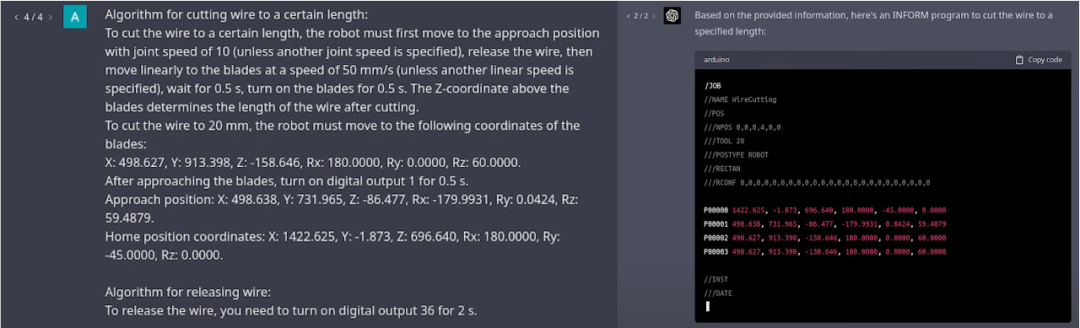
ChatGPT generating a program for a Yaskawa robot.
2. Invoke specific actions. Boston Dynamics has combined vision and language models with actions such as moving to a location, opening or closing a gripper, speaking, and asking questions. This lets people communicate with the robot and assign tasks naturally. In effect, the language model decomposes tasks and handles exceptions, while conventional perception, planning, and control execute the motions. The difficulty is that different robots do not offer the same actions. A capable intermediate layer is essential.
Giving a robot instructions in natural language.
3. Control the robot's actions directly. Google's RTX-2 combines vision and language to output end-effector actions, reducing reliance on that intermediate layer. But the same end-effector action need not have the same result on robots with different structures or configurations. Each robot may require retraining.

RT-2 and generalization across robot tasks.
4. Address generalization by collecting more data. The Open X-Embodiment project brings together manipulation data from many robots. Its ambition is to become an “ImageNet for robotics,” using a much larger dataset to help AI generalize across different embodiments. The hope is that scale will do the work.
The Open X-Embodiment dataset.
For a moment, it seemed as though general-purpose robots already had one foot inside our homes. I remain cautious about that optimism. Even a huge dataset leaves some difficult questions:
- In exactly the same environment, the same end-effector motion may cause a larger gripper to collide where a smaller one does not. Different physical properties can produce completely different outcomes from the same action.
- Even structurally identical robots can behave differently if their coordinate systems are defined differently. “Forward” might be the x-axis on one and the y-axis on another.
- Once the manipulated object's dynamics matter, following the same end-effector path at different speeds can also produce different results.
Someone might reply that a robot can learn its geometry and collision boundaries visually, calibrate its coordinates with a few movements, and discover object dynamics by experimenting. If you believe that, I have a bridge to sell you.

These experiments do offer new directions for embodied intelligence. Whether they can give us general-purpose robots is still an open question. We have not yet established that human consciousness is simply a chemical mechanism for processing enough input and output.
Making a body intelligent
This second path seems closer to practical use. Apply perception, planning, and related methods to a particular robot and setting, then generalize across tasks within those limits.
Companies such as Boston Dynamics have already shown robots with enough capability to localize themselves, navigate to a goal, and grasp objects autonomously. Add a large model for task decomposition and decisions about exceptions, and the overall system may display a useful amount of intelligence.
There are different approaches within this path, too.
1. Model-based planning and control. Given a robot model and a task, algorithms generate the motions needed to perform it. This provides a complete intermediate layer: instead of receiving every movement as an instruction, the robot plans its motions from the task logic.
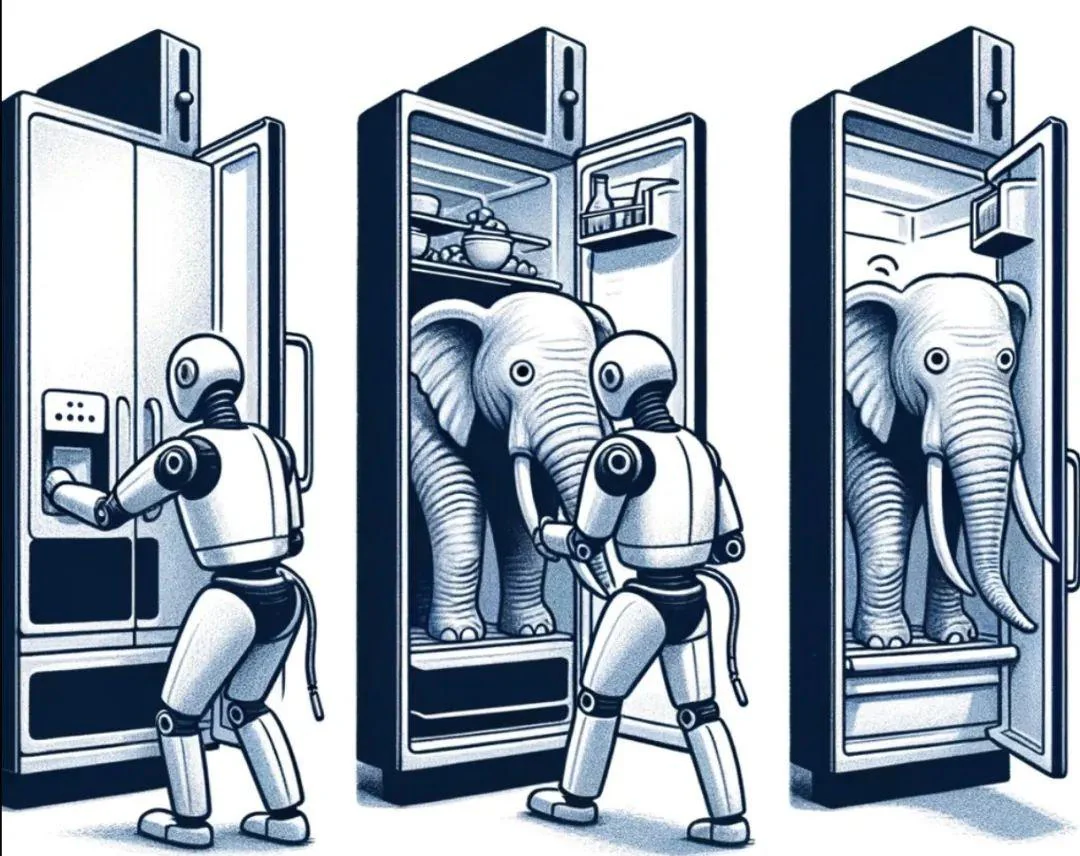
Open the refrigerator → put the elephant inside → close the door.
There may be a weld seam over there → move over and photograph it → move over and weld it.
Deployment still brings difficult questions:
- Where do we draw the boundaries between primitive actions? The intermediate layer needs basic units that can be reused across many tasks.
- How do we keep the environment representation current? A robot needs accurate, timely information to respond appropriately, particularly in dynamic or complex surroundings.
- How accurate are the models? Errors in kinematics, dynamics, or models of manipulated objects can make a robot inaccurate or unable to adapt, especially in unfamiliar or changing conditions.
2. Data-driven learning. On a fixed hardware platform, collecting data and continually improving actions can teach a robot the constraints of a manipulation task. This has already produced better generalization than traditional modeling approaches in some cases. The difficulty is collecting enough data on the same platform. Unlike a simulation, the physical world cannot simply run faster.
End-to-End Training of Deep Visuomotor Policies.
I have long thought that learning is a good fit for problems that are hard to model precisely but limited in scope—for example, force-controlled peg-in-hole assembly.
Some recent work has made the second path look more practical to me. We cannot speed up the physical world, but we can work in parallel.
One example is Tesla Optimus. If Tesla builds a large fleet of robots with standardized dimensions, data collected on one robot could be shared with the others. I would therefore expect Tesla to recruit many teleoperation demonstrators, repeatedly train and collect data in particular applications, and gradually turn that process into a deployable system.
Tesla Optimus.
If there can be only one hardware platform, a humanoid may be the most general-purpose choice. That may be the only compelling reason to build humanoids; for any individual application, there will otherwise be a better-suited mechanical design.
Another example is Stanford's Mobile ALOHA, which combines human demonstrations with autonomous execution. Beyond its impressive demonstrations, the project makes its design available as open source, allowing people and organizations around the world to collect and share data on the same platform.
Stanford's Mobile ALOHA.
The fact that people can perform all sorts of tasks by teleoperating ALOHA is also some evidence that human intelligence is capable of operating an unfamiliar body. :)
Perhaps the next contest will be between commercial scale and open collaboration.
Where the two paths might meet
Both approaches are still being explored, and each has advantages and difficult problems to solve. They may eventually converge, combining the generality of embodied intelligence with the practicality of making particular robots more intelligent.
We should learn a great deal from trying to bring them together. I expect robotics research itself to change profoundly as the technology develops. Robots could become more intelligent and adaptable, and play a larger role in everyday life and work.
“Making a body intelligent” is my way of expressing 身具智能, a term coined for this comparison. It is not an established technical category.
Some of the text and images were generated with ChatGPT.