More than half a year has passed since my last article, and the industry has hardly quieted down. In September 2026, I answered several questions about embodied intelligence on Zhihu:
- Why does robotics seem to have jumped straight to embodied intelligence?
- What does it mean for a world model to rehearse something “in its head”? Isn't that a simulator?
- Will embodied intelligence come from putting large models into robots, or from intelligence native to robots?
- What might GPT-6 Astra mean for the embodied-intelligence industry?
I won't repeat those arguments here.
When I wrote “Giving intelligence a body, or making a body intelligent?” in 2024, I was mainly sorting out concepts and possible routes. In “Rethinking embodied intelligence with control theory”, published at the beginning of 2026, I tried to examine those routes using control theory. Here is where I stand now:
The generality in a general-purpose robot will come from general-purpose foundation models. Robotics does not need a separate “embodied foundation-model brain.”
Why build another brain?
Cover up the word “robot” in the technical introductions from some embodied-model companies, and the rest looks familiar: Transformers, pretraining, post-training, reinforcement learning, scaling laws.
Text is split into tokens, so actions become tokens too. Image generation uses diffusion and flow matching, so action generation adopts them. Language-model companies crawl the internet; robotics companies build data-collection centers and teleoperation factories. Everyone imagines themselves as Ilya, waiting for robotics to have its GPT moment.
From architecture and training to faith in scaling laws, mainstream embodied foundation models are largely following the large-model playbook.
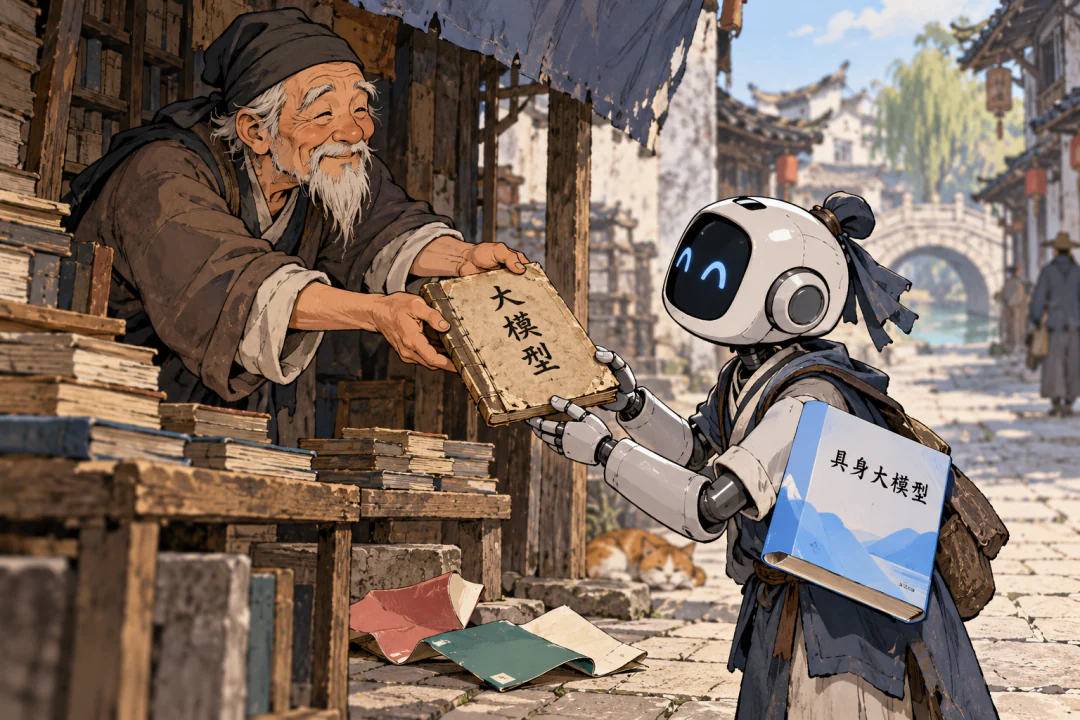
There is nothing wrong with borrowing a good method. But if the methods are fundamentally the same, why does robotics need a separate general-purpose foundation model?
Early language models dealt with text, while robots needed vision and action. The data seemed to belong to separate worlds. By October 2026, however, large models are no longer just LLMs. Images, speech, video, spatial understanding, 3D modeling, and computer use are becoming part of their capabilities. Interaction data from the physical world will be another part of that expansion. A model that understands language and uses tools has no reason to exclude physical understanding.
The general knowledge, multimodal data, training infrastructure, researchers, and compute accumulated by large-model companies will continue to matter. “We collect robot data” is unlikely to keep them out. Gemini Robotics adds robot actions directly to Gemini; Gemini Robotics-ER 1.6, released in April 2026, combines spatial understanding, task planning, and success assessment in one model, and can call VLAs and other tools.
Embodied AI does have its own inventions, most visibly vision-language-action models. But look inside them. RT-2 and OpenVLA start with a VLM and map discretized actions to vocabulary tokens, adding almost no robot-specific parameters. π₀ combines a roughly 3-billion-parameter PaliGemma with an action expert of roughly 300 million parameters. In Figure's Helix, the semantic S2 component is a 7B VLM, while the fast S1 component is an 80M visuomotor policy.
Most of the parameters belong to the VLM. The motion policy—the part specifically concerned with the robot—is comparatively small. And VLMs are precisely the business of large-model companies.
Consider what a robot needs to know to assemble a cabinet. It must read the instructions, recognize panels and fasteners, understand spatial relationships, and choose an assembly order. If a screw is missing, can another one substitute? If a panel goes in backward, how far must the assembly be undone?
Which of those forms of knowledge is unique to robots?
A person following the instructions needs them. So does someone designing furniture or generating a 3D model. Connecting a robot to the other side of the screen does not suddenly call for a different body of common sense about cabinets.
Of course, assembly requires seeing tiny clearances, welding requires following changes in the weld pool, and grasping requires detecting contact and slip. Learning suitable features and control policies for those tasks is necessary. It does not require relearning human language, common sense, and the whole world.
The more open-ended a robot's tasks become, the more its knowledge must extend beyond robot datasets. It is difficult to demand understanding on par with frontier general-purpose models while expecting far less data, compute, and research investment to catch up.
The models that make robots more general-purpose will come from large-model companies with sound technical judgment.
What is left for roboticists?
Today's GPT cannot beat AlphaGo at Go, but it can train an AlphaGo. I see robotics in a similar way.
After spending much of 2026 working closely with different large models, I have come to think of one as a person who knows an extraordinary amount about almost every field and is rapidly becoming more capable. There is just one catch: that person can only reach you by video call.
In the digital world, an agent harness lets such a model read files, operate software, write code, run tests, and revise its approach from the results. The harness supplies tools, a runtime, and feedback so the model can keep working toward a goal.
What kind of physical agent harness would it need to work in the real world?
In my 2024 article, I included an animation of excavator controls to illustrate our ability to learn unfamiliar tools.
Look at it another way. The operator uses levers to move the boom, stick, and bucket. They do not calculate how far each hydraulic valve should open or how pressure and flow should be distributed. The interface is reasonably intuitive.
Could an operator learn to control the valves directly? Perhaps, but it would take much more effort. And if every excavator introduced its own clever variation, forcing the operator to relearn the controls each time, the operator would probably go mad.
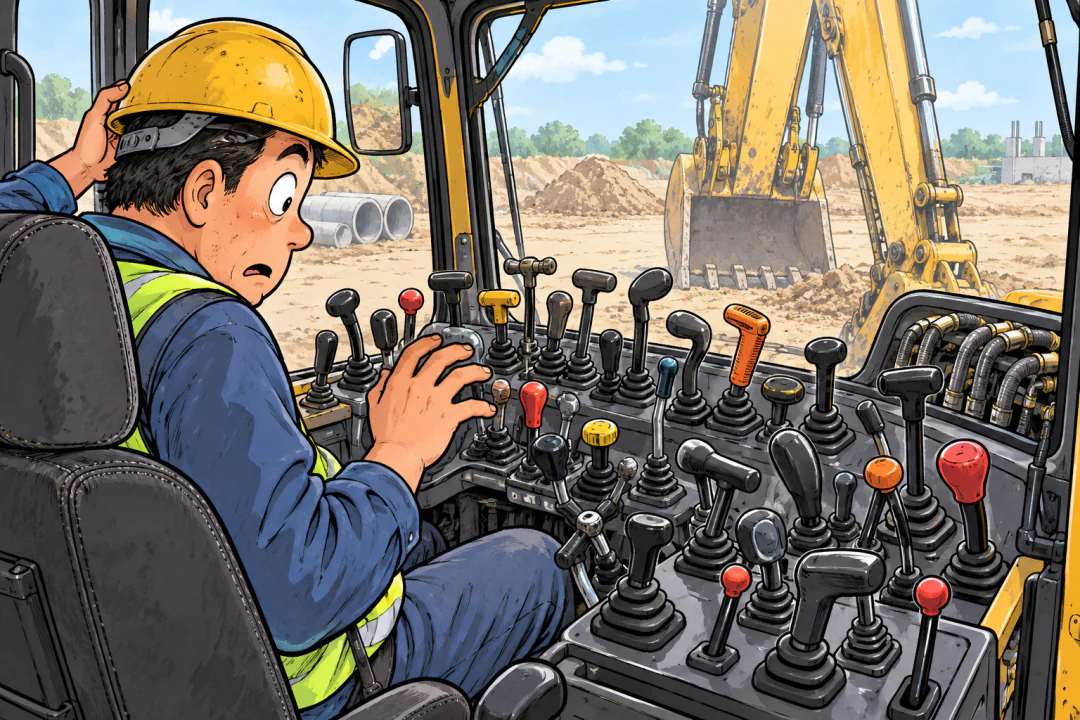
A large model faces the same problem with a robot. Asking it for individual joint torques is like asking the operator to turn hydraulic valves. Give it an end-effector pose interface, backed by inverse kinematics and trajectory interpolation, and it has usable controls. If “grasp this part” is already a reliable skill, the interface can move to a still higher level.
Recent experiments suggest several ways to use these models.
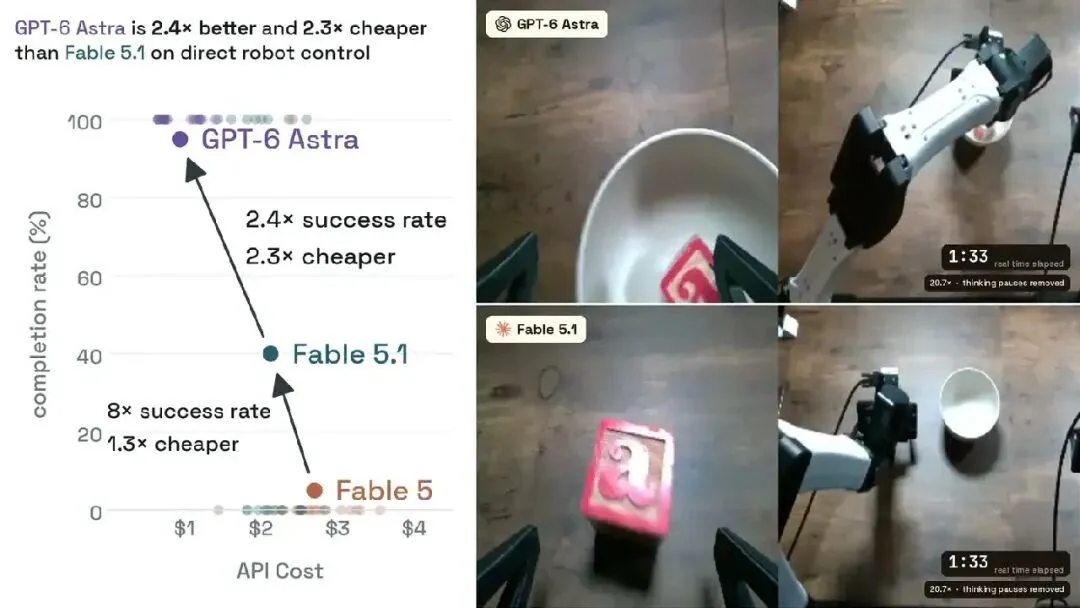
First, control the robot directly. The model interprets images and the goal, then issues end-effector commands or invokes existing skills. Robocurve's experiment used GPT-6 Astra to pick up blocks with an arm, with reasonably good results. Claude plays robotics tested several control modes, including seven-dimensional end-effector actions; direct joint control almost always failed, while higher-level interfaces worked.
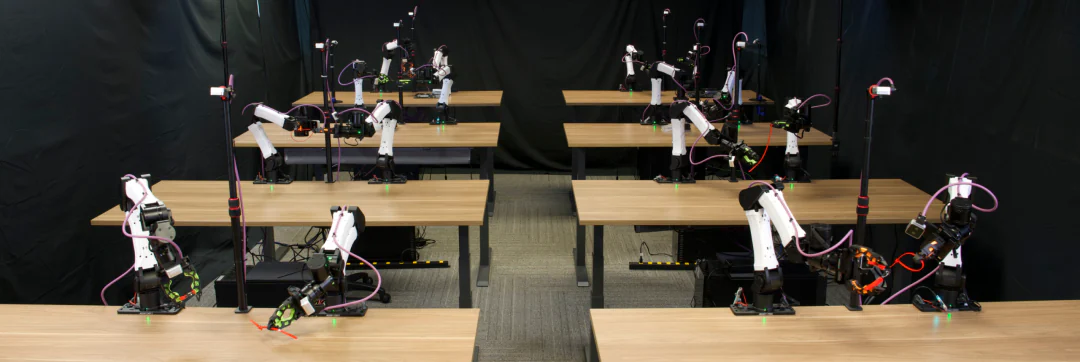
Second, act as a robotics engineer. Research the problem, write perception, planning, and control code, then revise it from the robot's actual behavior. ENPIRE places a coding agent inside a real robot experimentation loop, improving strategies for tasks such as inserting a graphics card, organizing needle boxes, and cutting cable ties. Human feedback first helps establish operating constraints, automatic resets, and acceptance checks. The model then proposes methods, edits code, runs experiments, and checks whether performance improves. The result is a control program that can run without the large model.
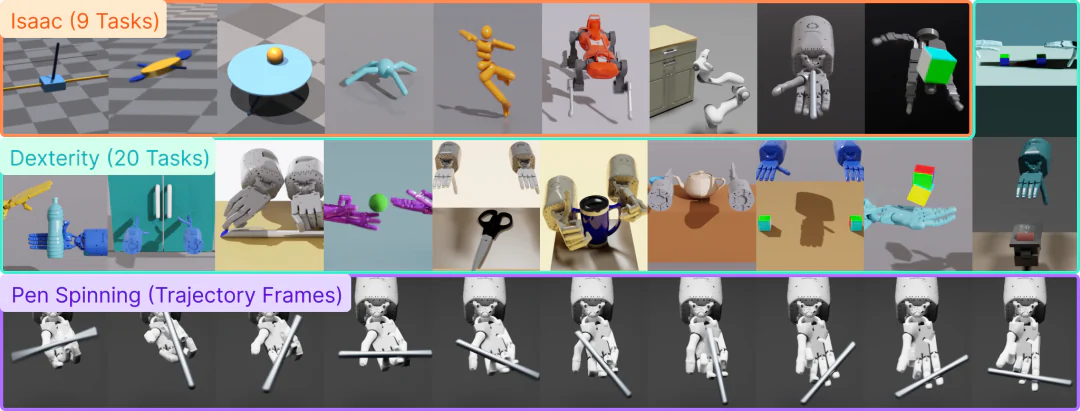
Third, train control policies. Read the task and environment code, design rewards, invoke simulation and reinforcement learning, then revise the training from its results. Eureka used GPT-4 to write and iterate on reward functions, training simulated skills in Isaac Gym, including pen spinning with a dexterous hand. The trained policy is what ultimately spins the pen.
The question for roboticists is therefore: what physical harness will increasingly capable general-purpose models need?
A set of interfaces is not enough
Would it be enough to expose our algorithms, provide programming and trainable-policy interfaces, and build dependable hardware?
No. For a start, today's task-specific robot skills are still weak.
Take welding. Detect the seam and calculate the torch trajectory, and the robot seems ready to work. But perhaps the camera never saw the back of the workpiece, or a fixture obscures part of the point cloud. Motion planning can then stall. An engineer still needs to add prior knowledge, change models, insert rules, or adjust sampling. A different setting may require starting over. Exposing weld() to a large model does not make that function capable of doing the job.
The same applies to humanoids. Without dependable locomotion, understanding “go to the kitchen and get a Coke” will not get the robot to the kitchen.
An interface exposes a capability; it cannot create one.
This is where learning-based robotics has room to contribute: extract task-relevant state from incomplete observations; use feedback to adjust actions during contacts that are difficult to model; learn local relationships in complicated processes and combine them with existing planning and control. These need not be large networks. Small sensorimotor mappings may be sufficient. During a weld, the controller needs to understand how the pool, gap, pose, and process parameters affect the next part of the weld. It does not also need to remember how to assemble furniture or make coffee.
Then there is the physical world itself: actions can be irreversible, and time cannot be sped up. Software is a convenient setting for agents because experiments are almost free, failures can be rolled back, and state is fully visible. Those assumptions do not hold in the physical world. A body that is easy to operate must, in my view, address at least four further problems.
1. Know whether an action is possible
The model asks: “Can you screw this fastener into that hole?”
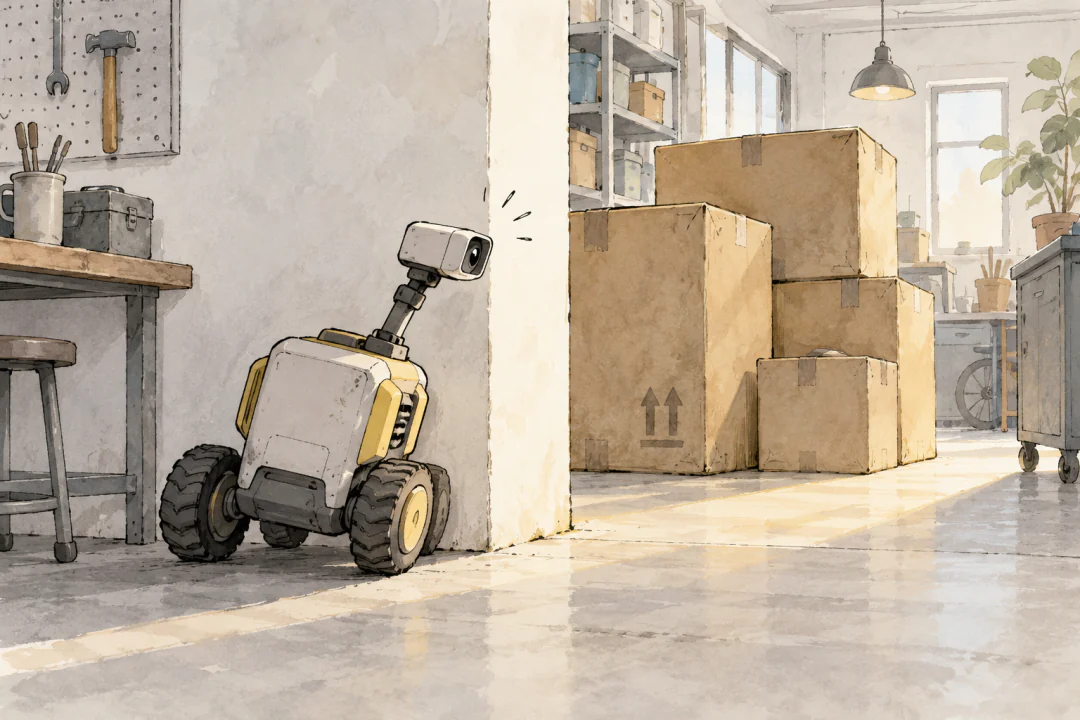
If the robot offers only an execution interface, it can try and report success or failure. But the attempt may already have damaged the part. The physical world cannot simply be rolled back.
Before acting, the robot must be able to assess whether it can do the task: an assessment of its own affordances.
“I can't” can mean at least three different things. The hole may be out of reach, requiring a new position or tool. It may be reachable, but the robot has no skill for this type of fastener and needs to learn one. Or the hole may be obscured, leaving too little information to decide. Each calls for a different next step from the higher-level system.
Tools can extend what a body can do. A chimpanzee whose fingers cannot reach into a termite mound uses a thin twig. In an intriguing neuroscience experiment (Iriki, 1996), after macaques learned to retrieve food with a rake, the receptive fields of neurons encoding space around the hand extended to the rake's tip. A familiar tool becomes part of the body's self-representation. There is a parallel with recalibrating a robot's tool center point after replacing its welding torch.
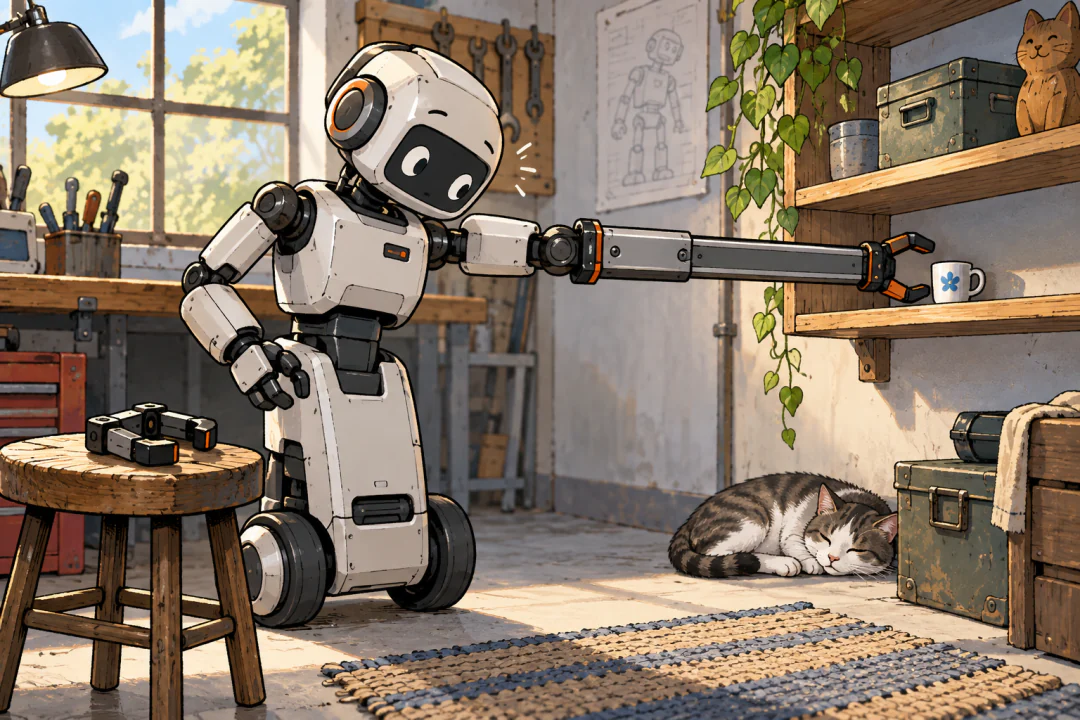
Deciding to find a stick or bend a wire into a hook, meanwhile, requires common sense and physical reasoning—strengths of large models.
2. The body must generalize too
The large model handles semantic and task generalization. But calibration errors, sensor noise, joint wear, changing loads, and small workpiece shifts can occur at any time. A model running at a few hertz may not be able to rescue the situation. The body needs generalization of its own.
Does that require a large network?
HORA (CoRL 2022) rotates objects within a dexterous hand using a policy of roughly 220,000 MLP parameters. A separate adaptation module estimates an eight-dimensional representation of object properties from recent joint and action history. After training in simulation, it can rotate real objects with different shapes, sizes, and weights. Reinforcement-learning policies for legged locomotion are often just a few MLP layers too. Earlier EigenGrasp work offered a related intuition: although a human hand has more than a dozen joints, its first two principal components explain over 80% of variation in grasp postures (Santello, 1998). Searching a low-dimensional hand-posture subspace dramatically reduces the problem.
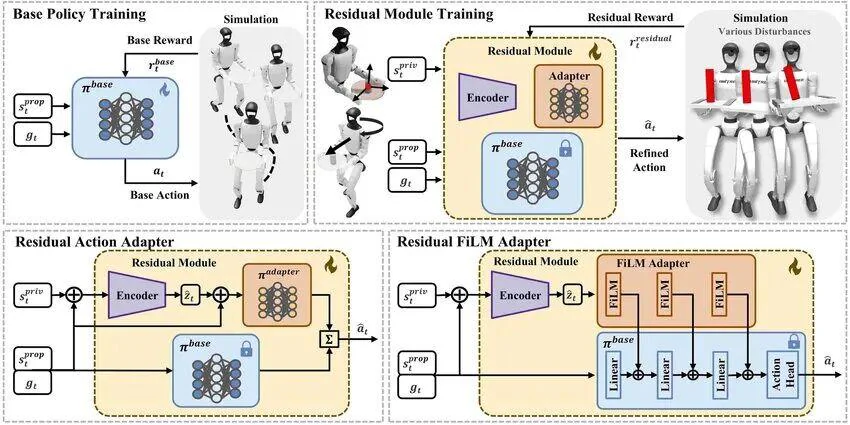
Yet training HORA's 220,000 parameters took roughly 500 million simulation steps, equivalent to about 7,000 hours of interaction. Legged RL has a similar pattern: a small network, but enormous amounts of simulated experience.
Many policies ultimately occupy a low-dimensional manifold. Representing them need not take a large network; finding them is the hard part, and that search consumes a great deal of data.
Learning control policies more efficiently is an interesting and important problem in its own right.
It also raises another question. If grasping, insertion, and transport each have their own small policy, how do they share experience?
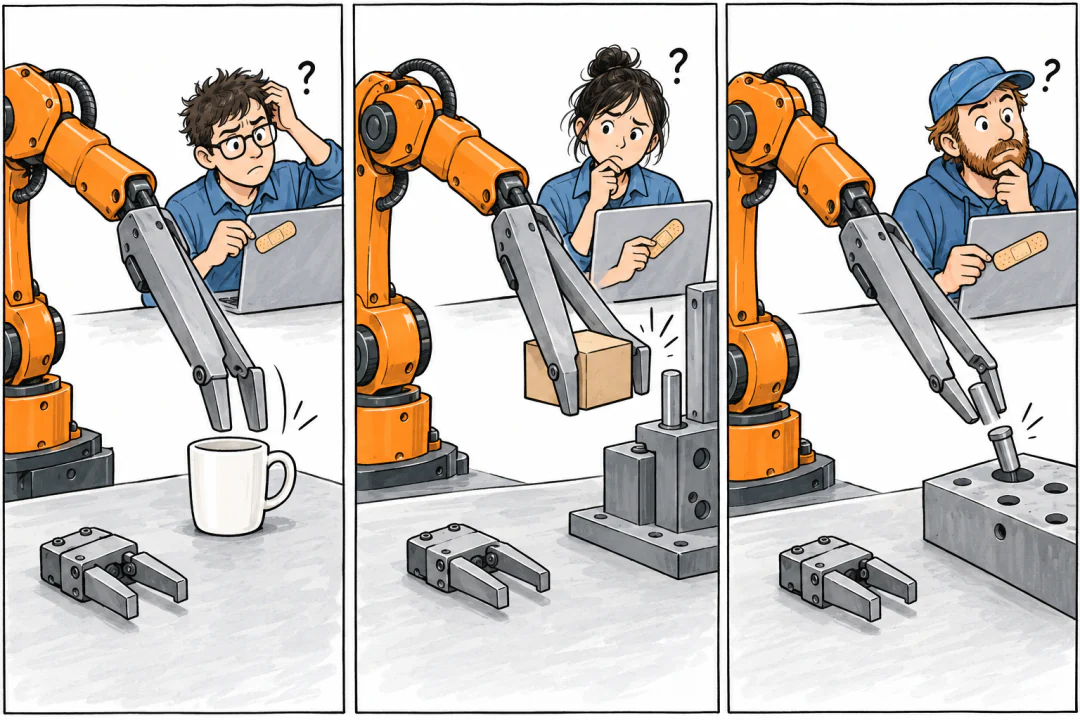
Suppose the robot gets a longer gripper. Its grasp is offset, so that policy gets a patch. It clips an obstacle while carrying something, so transport gets another patch. Insertion is misaligned, so we collect yet more data. Three tasks have separately learned about the same tool offset.
That makes little sense. The same physical cause should not need a different learned workaround in every task.
A robot needs a self-model that its tasks can share and correct. Kinematics, dynamics, tool frames, and collision geometry are familiar parts of such a model. Relationships between sensor signals and the consequences of actions should gradually become part of it too. HORA's eight-dimensional representation and RMA in legged control are early examples of this idea.
Infant development offers a useful analogy. A child does not first learn meters and centimeters and then decide how far away an object is. They reach, grasp, and crawl, gradually learning relationships such as “if it looks that far away, can my hand reach it?” Their body is the reference. Development also bounds exploration: short arms and limited strength confine early experience to nearby objects, before crawling and walking expand its range. Physical capability itself restricts the search space and reduces the risk of exploration.

A robot's self-model could grow in this way, or it could start with parameters learned in simulation and from other robots of the same type. Robots with identical or similar configurations could inherit a pretrained model and correct it using their own feedback. We need not make every robot start life from scratch.
3. Separate predictions from facts
Return to the unseen back of the workpiece in that welding example.
As I argued in a Zhihu discussion about world models, plausible and physically true are different things in robotics. A generated video may omit a cabinet behind a table without looking wrong. A robot that believes the omission may collide with it.
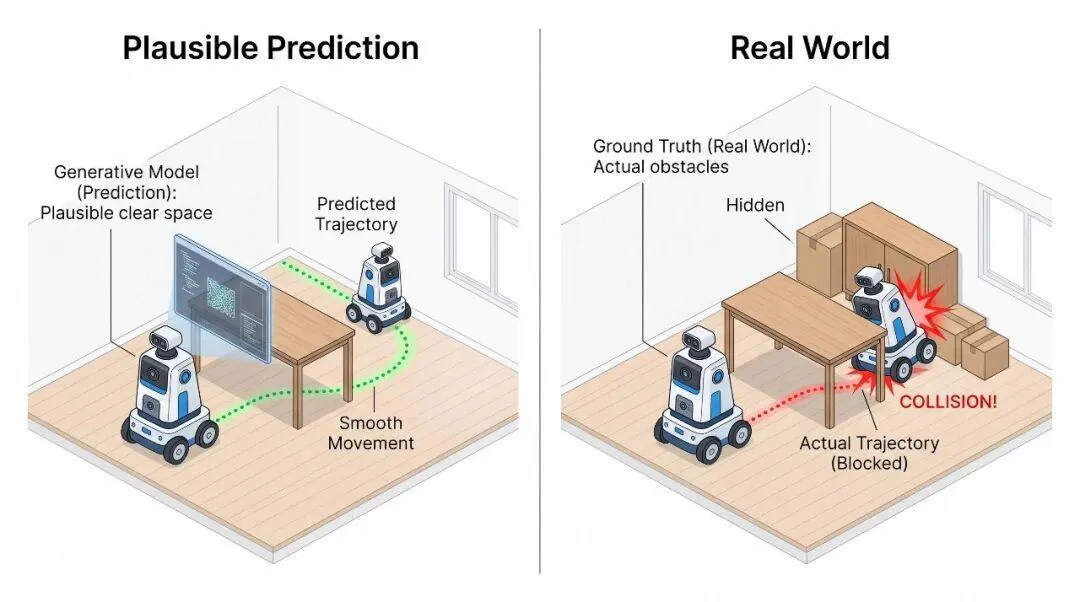
Not seeing something does not mean the space is empty. The system can take another image from a different position, choose a path around the unknown region, or probe it under controlled conditions. Perception need not be finished before action begins. Actions can themselves gather information.
The same applies to friction, clearance, and load—quantities vision may not reveal. This returns us to observability. A model will not know the gripper's actual force from two screenshots, nor infer the true clearance of a hole from common sense. But it can design an experiment: write a short test program, make a few exploratory contacts, estimate those quantities, and then decide how to proceed. For that to work, the robot must return structured feedback about torque, current, contact state, and process-sensor signals.
4. The first IKEA cabinet and the hundredth
What happens when the task is unfamiliar?
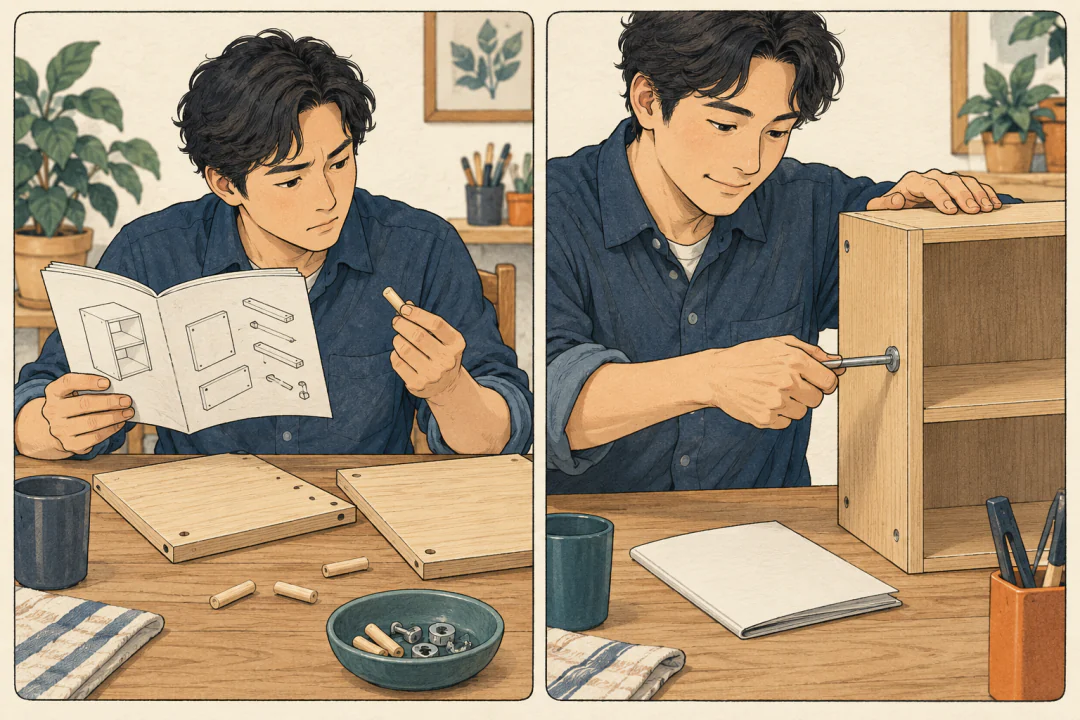
A reasonably handy person assembling a new IKEA cabinet starts with common sense and the instructions. They study the drawings, match the parts, work out the order, and undo a mistaken step. It may take a while, but they should be able to finish.
A robot could work similarly. The model reasons: read the instructions, consult the self-model, break down the task, call existing skills, or write code. The body executes: hold the panels firmly, align the connectors, and use contact feedback to complete insertion. A different cabinet should require the model to reorganize existing capabilities, rather than first collect a complete teleoperation dataset for that particular cabinet.
Still, completing the first cabinet is far from working like an experienced installer.
After a hundred similar cabinets, a person knows which panel goes first, which holes are easy to misalign, and what resistance indicates a crooked insertion. Many actions no longer need step-by-step thought; they can assemble while chatting. We call this muscle memory.
Tennis is similar. In principle, a projectile equation plus estimates of wind and ground elasticity can tell us where to hit the ball. Nobody actually plays that way. AlphaGo used Monte Carlo rollouts to estimate winning chances, then fitted a value network to turn such judgments into a kind of intuition.
Muscle memory is more than a subjective impression. Learning a new movement causes new dendritic spines to form in a mouse's motor cortex, some of which persist (Xu, Nature, 2009). Blocking the formation of new myelin makes it difficult for mice to learn new, complex motor skills (McKenzie, Science, 2014). Six weeks of juggling practice produces measurable changes in human white matter (Scholz, Nature Neuroscience, 2009).
The reverse can happen too. An experienced player who consciously thinks about wrist movement during a match may perform worse—the phenomenon sports psychologists call choking. I see a parallel with the near-total failure of asking a large model to control joints directly.
We do not need the model to think through every identical screw all over again.
A general-purpose model helps a robot accomplish something for the first time. The robot also needs a mechanism for developing muscle memory.
Where does that leave embodied-model companies?
If this argument is right, must companies building embodied brains shut down?
Not necessarily. There are many valuable robotics applications that conventional algorithms handle poorly. In a complicated assembly task, a slight shift in an incoming part, a different gripping position, or greater insertion resistance can defeat the original program. Keep the data and failure feedback from these processes, then train policies on focused, carefully selected data, and we may get generalization within that scope.
Find problems in real work, collect data, improve the model, and verify the result. That feedback loop is more practical than recreating a general-purpose brain, and it can solve substantial problems.
But a model has limited capacity, and its training data is concentrated. Move to another application, and little may carry over.
The important thing is not to fool ourselves.
This is still an interim solution
So far, this may sound as though a sufficiently capable general-purpose model, enough physical skills, and a good connection between them will give us an intelligent robot.
In a Zhihu answer, though, I distinguished three meanings of “general-purpose robot”:
- Level 1: A new kind of intelligent agent with a reasonably stable sense of self, long-term goals, and the ability to accumulate experience continuously. It decides what to do and learn next—perhaps even exploring the universe and developing civilization on our behalf.
- Level 2: A robot that generalizes across a broad class of settings, such as homes or manufacturing. It has no long-term goals of its own, but can understand and decompose tasks, adapt to changing objects and environments, recover from failure, and learn new tasks from a few attempts.
- Level 3: A robot for a particular process, such as welding, packing boxes, or folding clothes. Within defined task boundaries, it handles a range of variation while meeting requirements for accuracy, cycle time, stability, safety, cost, and maintainability.
By this definition, a general-purpose model plus a physical harness, a self-model, and small policies can make Level 3 work well. It may gradually approach Level 2. It does not get us to Level 1.
We still decide what counts as a state or skill, how the system explores, and how it is evaluated. People define task boundaries, build training environments, and largely decide in advance what is worth retaining. A model can participate, but participating in a training run is a long way from being a continuously learning agent. Until major new advances in compute, architectures, and learning theory arrive, this is an interim arrangement.
Our understanding of intelligence remains rudimentary. Even in machine learning, we know how to use these methods better than we can explain why they work.
The eventual system may not be one unified, enormous network.
The human nervous system is an interesting example. Basic units such as neurons form the hippocampus, cerebellum, cortex, and other structures, each with different organization and biases, yet able to work together. Under some conditions, damage to one function can prompt reorganization and compensation.
Perhaps what we need is a simple, shared basic unit and learning mechanism. Such a system could develop structures for memory where it needs memory, and short, rapid pathways where it needs fast control. Faced with a new problem, it could change its representation and structure, continuing to learn through interaction.
The divisions we now draw by hand between a large model, a self-model, and small policies may eventually be learned by the system itself.
Sutton's The Bitter Lesson argues that general methods of search and learning that continue to benefit from compute will, over time, outperform many hand-designed approaches. The interfaces, skill boundaries, and self-model proposed here are hand-designed too.
But that does not mean today's network, more data, and indefinite scaling will be enough. Scaling depends on having the right structure: scaling an LSTM does not produce ChatGPT. Which methods can turn more computation into more capability remains a question for research and judgment.
Does this overturn my earlier argument? I do not think so.
That eventual system will probably also emerge from the general-purpose-model side. It will be a general-purpose model that acquires a body, rather than a robot brain that acquires generality.
In the long run, genuine intelligence should not be tied to a particular form.
At first, a mountain is a mountain. Then it is no longer a mountain. Eventually, it is a mountain again.

October 16, 2026 — Tiandu Peak, Huangshan.