An unusual kind of excitement
It has been about two years since my last substantial technical article.
The excitement around embodied intelligence during those two years has exceeded my expectations. I was convinced that data-driven methods such as reinforcement learning and deep learning would become part of robotics, but I did not expect the change to come this quickly. In humanoid locomotion, RL has swept through the field, almost replacing conventional model predictive control (MPC). Policies trained in simulation now let physical robots perform difficult movements. To me, these advances are further evidence that data-driven methods are the future, and will gradually change how many fields conduct research.
Yet there is something unusual beneath the excitement.
Robots are not just for dancing. Many humanoid and embodied-intelligence companies announce mass production, factory deployment, or entry into ordinary homes. In actual factories and everyday life, however, we rarely see embodied robots working reliably at scale, in applications that can be replicated elsewhere. We mostly see lab demos and carefully edited videos. Even some deployed applications still depend heavily on rules and hard-coded strategies.
During a conversation with several embodied-AI researchers in 2025, I could not resist asking:
“Do we really need to learn inverse kinematics too?”
I was asking about neural networks generalizing across kinematics, but what bothered me was the direction the field was taking. Strip away terms such as “embodied intelligence” and “large models,” and examine these systems through classical control theory: what are they actually learning, and what are they leaving out?
Back to the foundations of control theory
To make the question concrete, we need a few basic concepts from modern control theory. Technology changes; the laws of the physical world do not.
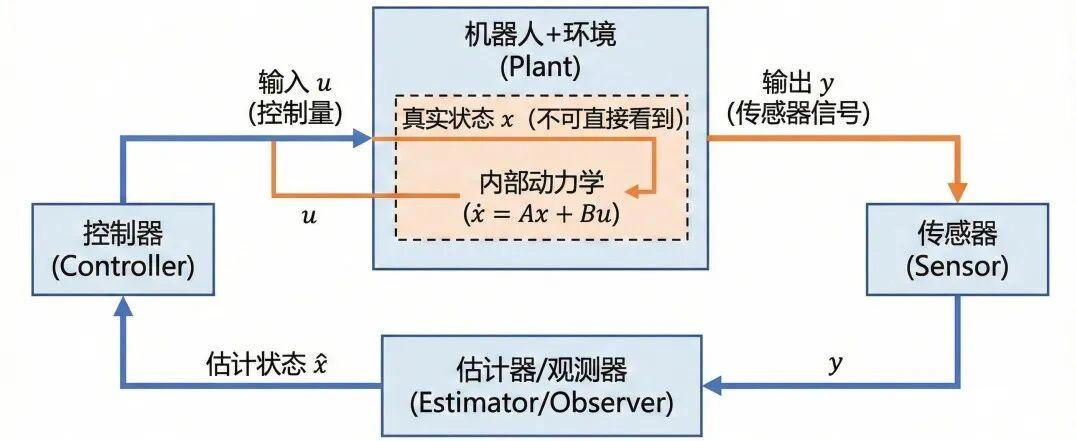
Control theory describes a system—for example, a robot together with its environment—using state-space equations:
- State, : The internal quantities that determine how the system changes—its internal memory. Examples include position, velocity, contact force, and even friction coefficients.
- Input, : The control we apply, such as motor current or joint torque.
- Output, : What sensors can measure, such as images or encoder readings.
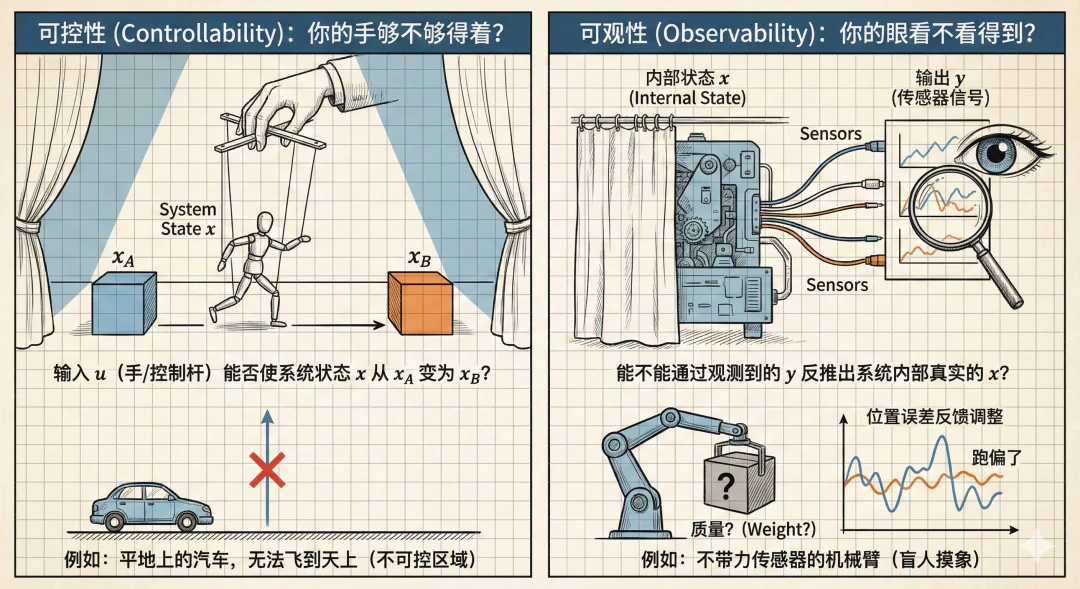
Two properties define important limits on interaction with the system:
- Controllability: Can we reach the state we want? Can an input move the system from to ? No amount of steering or acceleration will make an ordinary car fly.
- Observability: Can we determine the internal state from the measured output ? If not, feedback control is feeling its way in the dark. Consider an arm moving heavy objects of different masses at high speed, without a force sensor or knowledge of the load. It must wait for a positional error before adjusting its control, making precise, smooth motion difficult.
These principles expose tensions in the current embodied-AI stack without getting caught up in the latest model terminology. VLA, world model, reinforcement learning, imitation learning—we can ask all of them the same questions:
What role do you play in the feedback loop? What assumptions about observability and controllability do you rely on? Are you responsible for stability?
What are VLAs and world models learning?
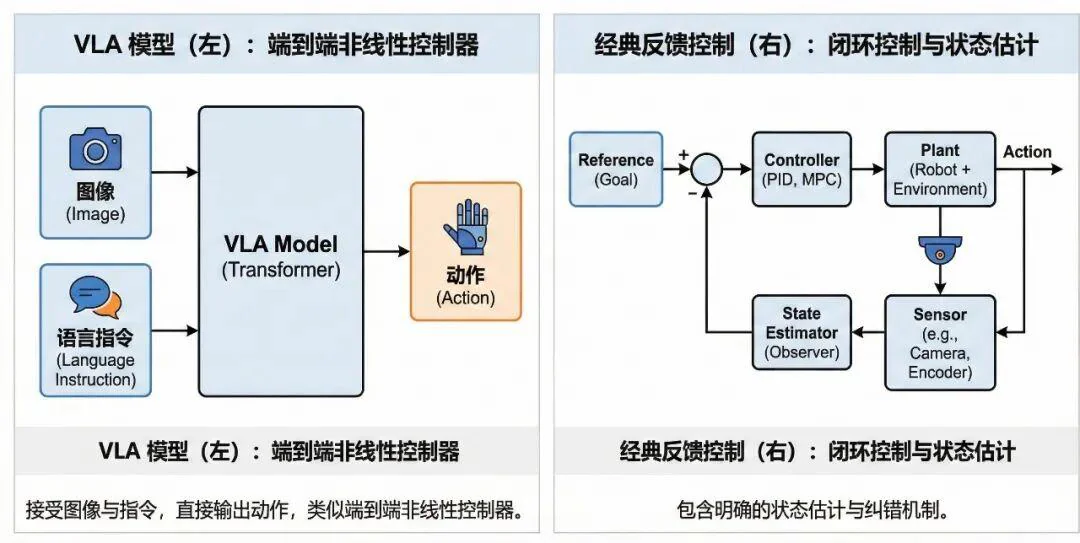
1. A VLA as a static nonlinear output-feedback controller
A vision-language-action model, as used in early 2026, is essentially a very large static nonlinear output-feedback controller. It takes an image and a text instruction , then produces an action :
This is an attempt to control a complex system with an end-to-end nonlinear control law. Because the output is a low-level action, it is difficult to constrain the model's internal decisions. The overall system lacks intermediate interfaces through which those decisions can be controlled. That helps explain the fragility of VLAs outside their training distribution: explicit physical constraints and correction mechanisms are missing.
2. A world model as an observer and a dynamics model
“World model” does not yet have one settled meaning. Different researchers may mean very different things by it. From a control perspective, though, two components stand out:
- State estimation: Use observations to understand and update the environment's internal state, including the situation the robot is in.
- Dynamics prediction: Predict how that state will evolve under different inputs.
In other words, a world model learns something like the system evolution described by
alongside a mechanism for recovering from . Its latent vector represents state, while its learned transition function plays the role of .
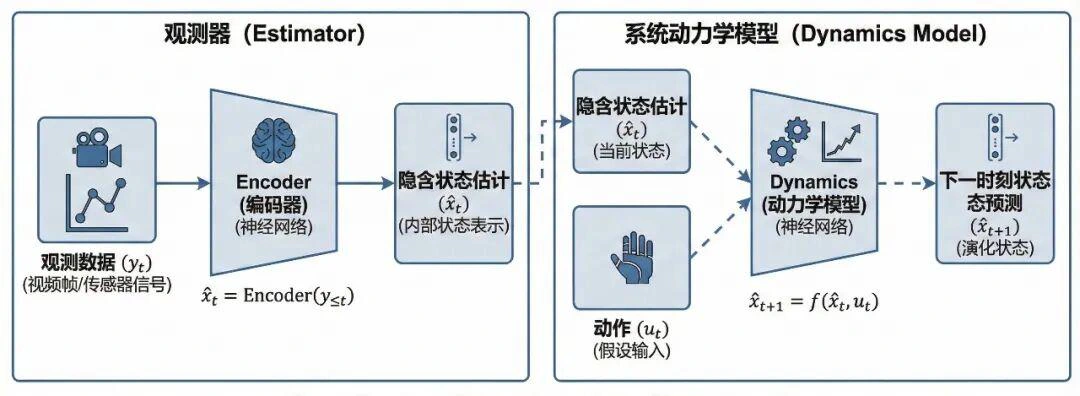
From this perspective, the model uses data to learn state variables and dynamics that can support decisions, such as planning or an RL policy. The idea has close parallels with classical system identification and state estimation.
Four structural gaps
Embodied AI has demonstrated impressive generalization. But control theory points to some conspicuous structural gaps in existing methods. These are the sort of gaps that let a demo look good while causing problem after problem in deployment.
1. Observability can collapse in latent space
Many quantities that matter in manipulation—mass, friction, viscosity, assembly clearance—are weakly observable in images. They may barely change the pixels while having a major effect on the dynamics.
World models and VLAs tend to learn features that are easy to predict, such as visible pixel changes. They may compress away variables that matter most for control, leaving the controller to make decisions from the wrong state. If the estimator cannot disentangle and explicitly represent these physical properties, calculations based on its state will be wrong too.
This interactive example illustrates the intuition. If training points cover only the XY plane, the model's segmentation looks almost perfect from directly above. Rotate around the X-axis to reveal the hidden Z dimension, however, and the blue region turns out to be a thin shell along the training plane, rather than coverage of the wider distribution. If data omits important hidden variables—friction, clearance, load—the model may simply overfit an in-distribution projection and fail systematically outside it.
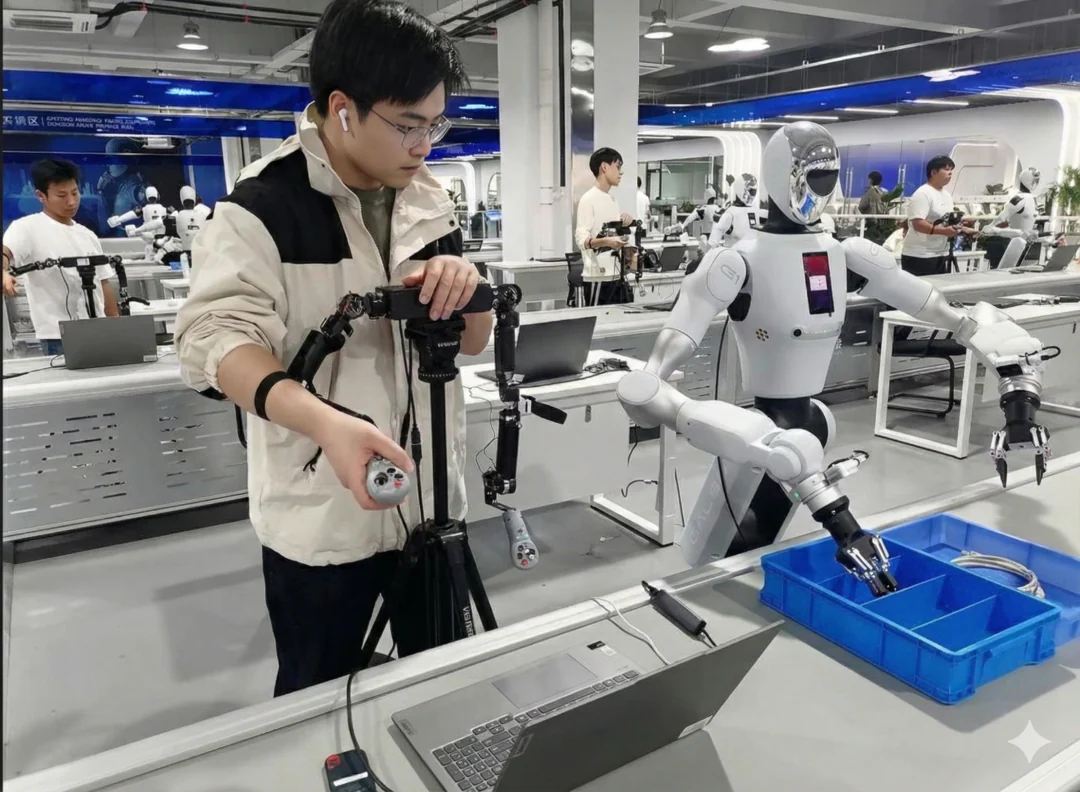
Some teleoperation data collection has this exact problem: the operator watches the robot directly rather than watching its sensor images. Information the human uses is missing from the robot's data, creating an observability gap. The robot appears to have learned a skill and can repeat it in the same setting. But if important factors never varied during training, that apparent competence may be overfitting that ignores those factors. Outside the training distribution, the output becomes unpredictable.
2. Stability is left unproven
A common pattern in classical control is to establish stability and then optimize performance. Many learned policies follow a different pattern: raise the reward, then hope the test set reveals no disasters.
What is missing is a verifiable constraint, such as a Lyapunov condition.
I do not believe that a method is unusable without a rigorous proof. Control engineering also relies on approximate models and practical tuning. The distinction is that a control system knows what its safeguards are—gain margins, phase margins, robustness bounds, fallback strategies. A purely end-to-end system often does not know where its safety boundary lies.
3. Bandwidth mismatch and missing layers
At the time of writing in January 2026, VLA inference is very slow, typically 3–10 Hz. Sampling-theorem and control-bandwidth considerations mean that stable contact between a rigid robot and its environment usually calls for control above 100 Hz. A controller running at 5 Hz introduces substantial phase lag, eroding phase margin and potentially causing oscillation or divergence.
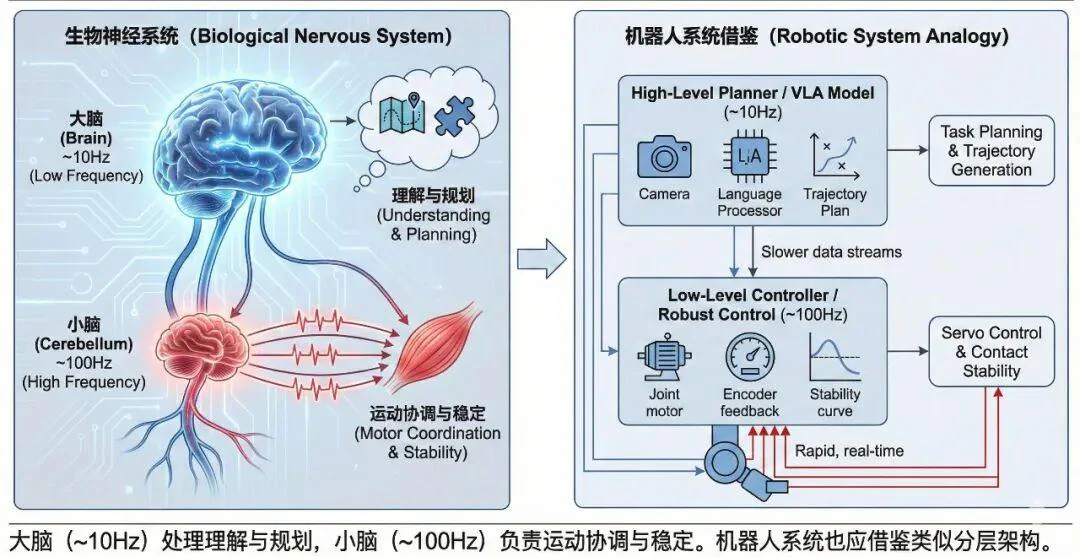
I do not see this as a problem solved simply by adding a little more compute. It suggests a division of labor closer to biology: the brain handles understanding and planning at low frequency; the cerebellum handles stability and reflexes at high frequency.
AI coding offers a useful parallel. Coding models have improved rapidly, but they still cannot handle every issue precisely. Context limits and probabilistic reasoning affect the outcome of an entire project. MCP and Skills introduce layers: an agent handles abstract coordination and interaction, while tools and skills provide deterministic, verifiable execution. Robotics, where errors are less tolerable, has even more reason to adopt this separation.
4. Physical consistency and feedforward linearization
End-to-end networks are trying to relearn and trigonometry from data. That is extremely inefficient. Classical feedback linearization and computed-torque control use known rigid-body dynamics to cancel nonlinear terms such as gravity and Coriolis effects. Geometric kinematics relates end-effector motion to the actuated joints, presenting a linearized system to the upper layer. Future architectures should incorporate known physical equations as inductive biases.
Some practitioners will respond that enough data will give models the knowledge and experience to overcome all these problems. My objection is this: end-to-end learning is not inherently wrong, but betting everything on scaling laws is not a sufficiently rigorous scientific position. At least, it is not a responsible engineering one.
Internet video as a foundation for world models
My intuition is that the vision-language part of current VLAs does not truly encode or understand physical laws. Vision describes the scene; the language model is then expected to reason about physics through the linguistic probabilities it has learned, on the assumption that language already encodes world knowledge. For details such as material properties and manufacturing processes, the small action decoder is expected to combine visual features with language knowledge, learn the missing properties, and learn the corresponding control policy as well.
These are conceptual divisions based on where capabilities come from and what they do. The actual model is a complete network, not a set of perfectly separate boxes.
This leads me to a strong intuition:
The data for truly large-scale robot foundation models may come primarily from real videos on the internet, rather than recordings from physical robots.
Internet video shows a vast range of settings and physical processes unfolding over time. From it, models may be able to learn the dynamics of the physical world.
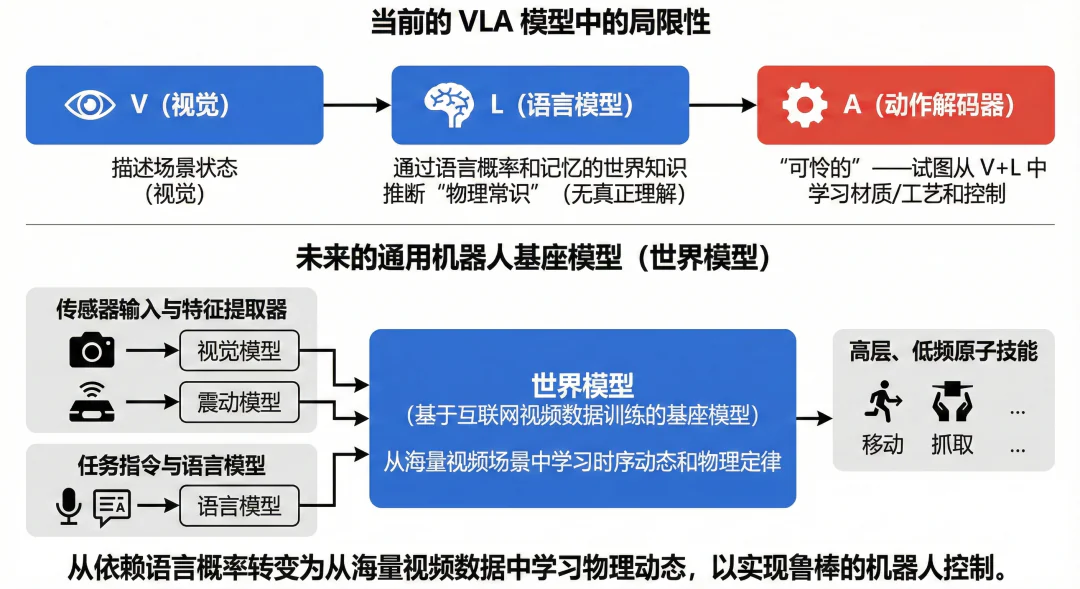
On this view, a future general-purpose robot brain might be based on a world model trained on internet video. Its inputs would include sensor information and feature extractors for estimating world state—images and visual models, for example, or force-sensor input and vibration encoders—along with task instructions and a language model. Its outputs would be higher-level, low-frequency robot primitives, such as moving and grasping.
Reinforcement learning: the right idea, but where does the data come from?
Even with world knowledge and sensors that make the system observable, one problem remains: how to produce control policies. A trainable policy head, as in a VLA, can learn basic behavior quickly through supervised or imitation learning. But for a robot to keep learning and deal with situations beyond its dataset, I see reinforcement learning as an unavoidable step.
Reading Sutton's reinforcement-learning textbook gave me a strong intuition: this is how people learn; this is the right idea. Later developments in AlphaGo, DeepSeek, and humanoid control reinforced that view.
But moving from “the robot can move” to “the robot can do useful work” is where the trouble begins. RL is powerful. Continually learning in the real world while staying safe remains a hard problem.
1. Dancing is easier to reward than welding, threading shoelaces, or tidying a room
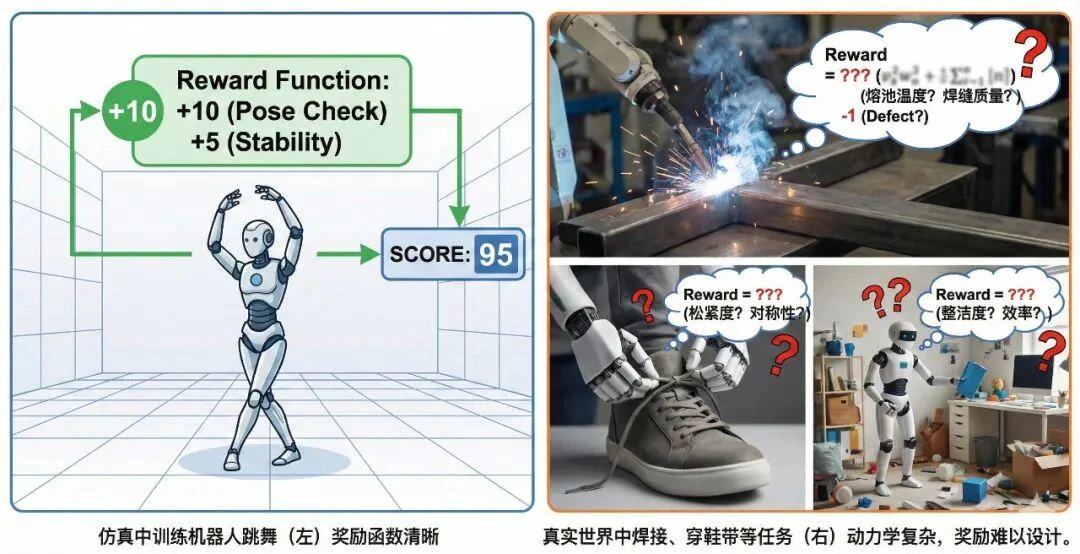
In locomotion, the dynamics are relatively simple: mainly the robot's own dynamics and contact forces with the ground. Rewards such as speed, energy use, fall penalties, and imitation of human motion are reasonably clear. We can simulate and iterate with useful accuracy.
In manipulation, both the dynamics and the reward may be complicated or unclear. Consider subtle changes in a weld pool under different voltages and materials; deformation in shoelaces made from different materials; or unknown physical properties of objects found in a room. A cup on a table might actually be a decoration fixed to it.
These systems are difficult to simulate accurately, and difficult to express with one reward that is both correct and practical to optimize.
2. Real-world RL must reconcile exploration with safety
If simulation is inadequate, why not collect data by exploring the real environment? Because RL needs exploration, and the real world does not permit unrestricted experiments.
Adding a safety operator, an emergency stop, or remote takeover does not make this conflict disappear. More credible engineering approaches often involve:
- Letting RL improve performance while deterministic control provides safeguards: impedance control, robust control, constraints or barrier functions, and fallback strategies.
- Keeping learning within controlled limits: constrain the action space, contact modes, and energy injection.
- Making the full lifecycle traceable and verifiable: data calibration, version rollback, testing, and validation.
Toward integration
The purpose of this criticism is to find a better approach, not to dismiss the field. My current judgment is:
The next breakthrough will come from putting physical laws into a model's training rules or structure as inductive knowledge, or putting learned networks inside a control loop—not from asking AI to relearn from scratch.
AI offers semantic understanding and generalization; control theory offers precision and stability. I see the future in combining them closely.
1. A hierarchy of planning and fast control
Future intelligent systems should have a hierarchy resembling that of biological nervous systems:
- The brain—VLA or world model: Runs at low frequency, around 1–10 Hz. It handles multimodal perception, long-horizon planning, semantic understanding, and unfamiliar situations. It outputs reference trajectories and action strategies, rather than joint angles or torques.
- The cerebellum—classical or robust control: Runs at high frequency, 1 kHz or above. It handles servo control, contact stability, gravity compensation, and disturbance rejection. Physical interaction at this layer remains safe and compliant even when commands from above change abruptly.
- Data-driven dynamics models: For manipulation processes that resist analytical modeling, learn small models that approximate the task dynamics. Combine them with conventional methods such as MPC to make the fast control layer more robust.
2. Neural Lyapunov control
To address safety and trustworthiness, research will move toward verifiable AI. Alongside the control policy, train a network to approximate a Lyapunov function . Constrain policy updates with
A policy trained this way would not merely perform the task: it could also provide a mathematical estimate of its region of stability, identifying the range within which the robot is absolutely safe.
3. Online system identification and adaptive control
VLAs need in-context learning, which from a control perspective is adaptive control. When a robot picks up an unfamiliar object, it should use the prediction errors from the first few frames to update the mass representation in its latent state and immediately adjust its policy.
Use AI to fit small physical or process models. Through online evaluation, learn changes in a weld pool, fabric properties, or surface smoothness, then combine that learning with deterministic methods such as MPC.
A firmer foundation
Robots are part of the future, but that future should not be built on sand. We need the discipline of control theory to constrain AI's imagination, and AI's ability to generalize to extend the reach of control theory.
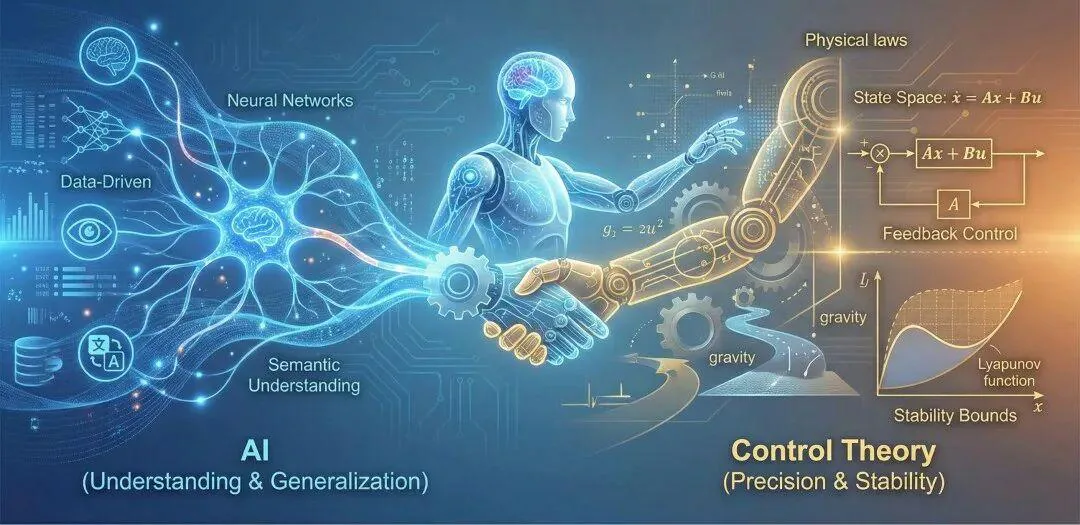
Let large models understand the world, and let control theory measure it. Their close integration may be the necessary route to general-purpose robots.
All images and videos in this article were generated or processed using AI. NotebookLM generated this podcast video from the article: